
Return to Play — ACL and major-injury rehabilitation for field-sport athletes
Coming back from a serious injury is daunting. Nine to twelve months out of the sport you love, and the gap between “discharged by physio” and “back to competitive 90 minutes” is bigger than most players realise. That gap is what I do.
I work with footballers, rugby players and other field-sport athletes — youth and adult, amateur and semi-professional — to build them back to performance after ACL reconstruction and other major lower-limb injuries. The programme starts where your physio finishes and ends with you back on the pitch, faster and stronger than before.
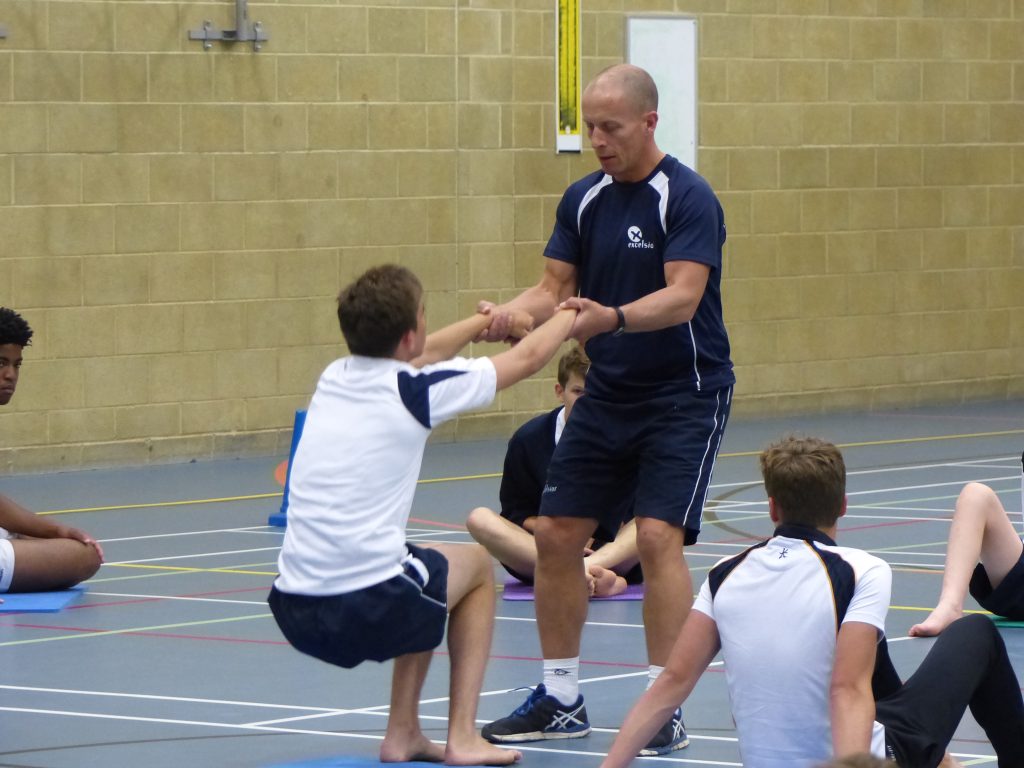
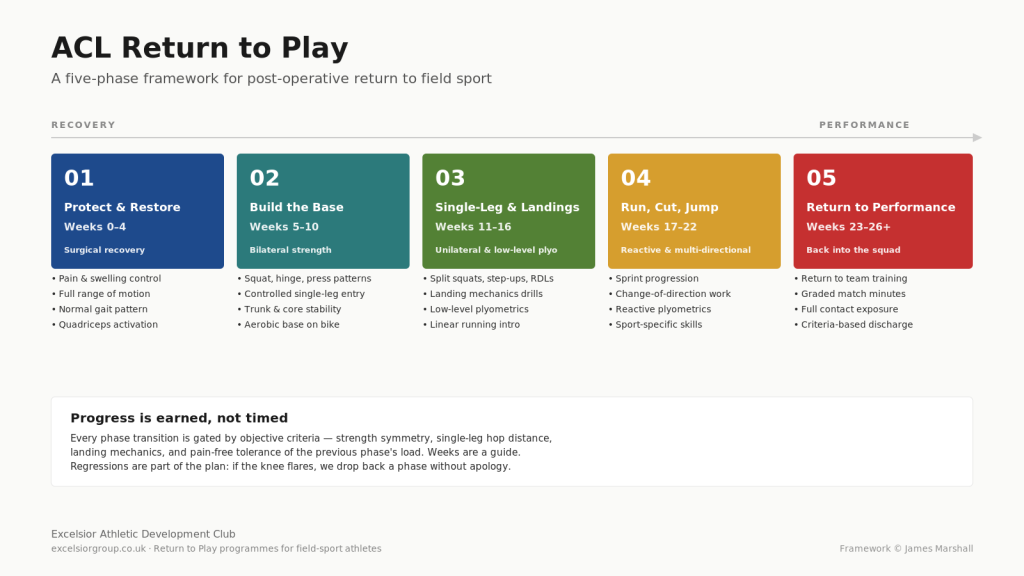
I normally start working with athletes at the beginning of phase 2, but I can also start at phase 3. The key point to remember is that you should be doing some exercise as soon as you have been operated on (under medical guidance).
If you have suffered a knee injury and are waiting for an operation, your outcomes from surgery are improved if you are stronger before you go in: it is best not to wait for weeks/months because the return to play is harder.
My approach — four principles
Coach the person, not the injury. A rehab programme has to be motivating, varied and visibly progressive. Sheets of paper and “see you in a month” do not get athletes back.
Train the whole body, not just the knee. ACL injuries rarely come from the knee alone. Drawing on a coaching background in gymnastics, athletics and weightlifting, I rebuild movement patterns across the whole body.
Load where you can. While the knee recovers, the rest of the athlete’s body is trained hard. You stay an athlete, not an invalid.
Put it together. Strength, speed, change-of-direction, contact, and decision-making are layered back in until you can withstand the demands of a full match.
Every phase transition is gated by objective criteria – strength symmetry, single-leg hop distance, landing mechanics, and pain-free tolerance of the previous phase. Weeks are a guide. Progress is earned, not timed.
In their own words
“I ruptured my ACL back in August 2015 playing football for Tiverton Town FC. I had just rejoined the club after 12 years and I had planned to play for a couple more seasons before retiring. In just my 5th game of the season I endured the worst injury of my career, and at 36, many said that I would never play again — and I too, once I heard the news, thought the same.
Luckily, I knew James Marshall before my injury, and speaking to him prior to my op, I decided to carry out my rehab with him after the initial first couple of months doing the NHS rehab at Heavitree Hospital.
As it turned out, it was, in my opinion, the best decision I have made in many years. Not only did I return to play for Tiverton Town FC again less than a year later with my knee feeling as good as it did prior to my injury, but my body as a whole felt like it did 10 years ago. This is due to the strengthening exercises and drills that James put me through on a weekly basis.”
— Scott Rogers, manager, Weston-super-Mare AFC
What the evidence says
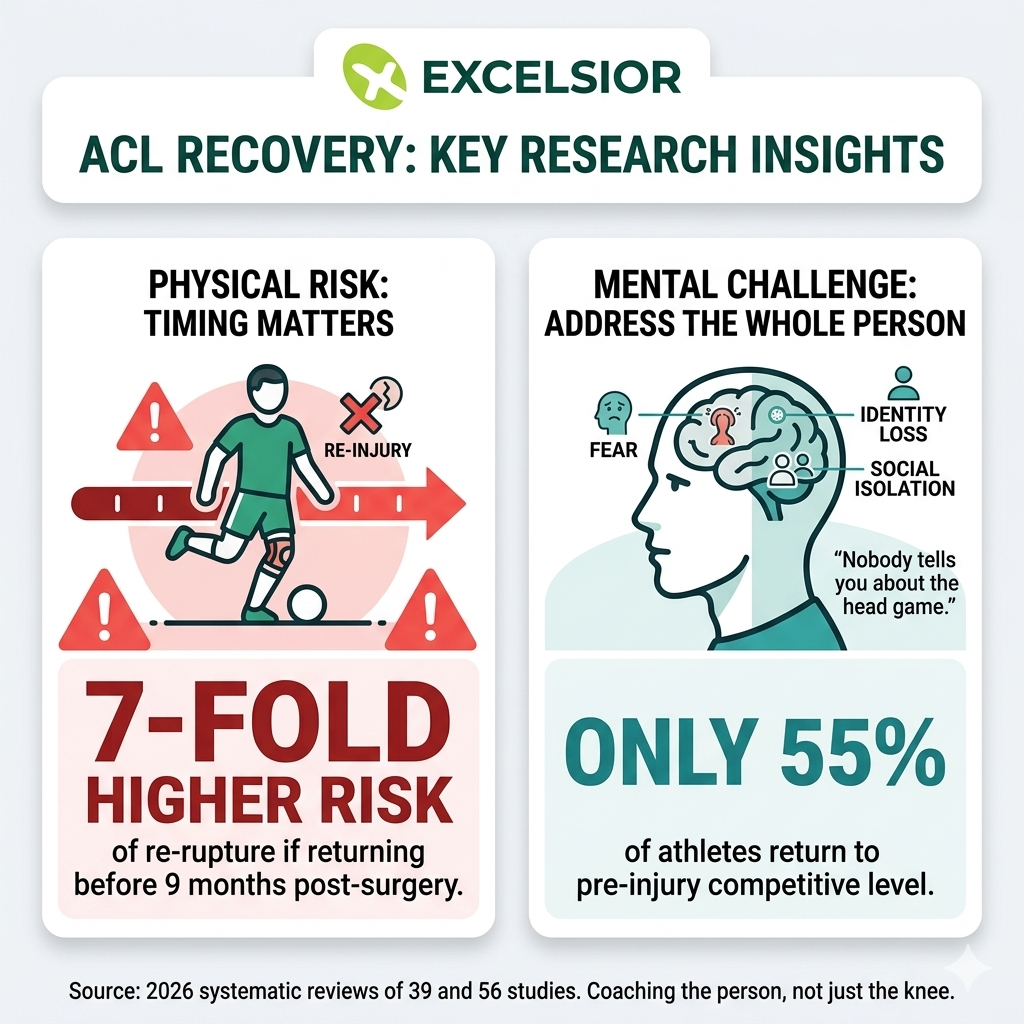
A 2026 systematic review of 39 studies and almost 1,500 footballers found that the average time to return to matches after ACL reconstruction is around 250 days — roughly eight months. Returning to full training takes around seven. Footballers who return before nine months post-surgery have a seven-fold higher risk of re-rupture, and the overall re-injury rate after ACL reconstruction sits at around 18%.
The review’s headline recommendation: prioritise individualised, criteria-based progression over fixed timelines, and clearly distinguish between return-to-training and return-to-match. That is exactly the framework I run.
A second 2026 review, this time of 56 qualitative studies covering 806 ACL patients (British Journal of Sports Medicine), filled in the rest of the picture. Only around 55% of athletes return to their pre-injury competitive level. The recurring patient complaint — captured in the title of one of the review’s themes — was “Nobody tells you about the head game.” Fear of re-injury, lost athletic identity, and social isolation are routinely under-addressed in standard rehab. Coaching the person, not just the knee, is the explicit answer the evidence asks for.
- Wagemans J et al. Time to return to sports in football players recovering from lower limb soft tissue injuries: a systematic review with meta-analysis. BMJ Open Sport & Exercise Medicine 2026;12:e003245.
- Kaplan S et al. ‘ACL — wow, this is bad’: patients’ perspectives on their anterior cruciate ligament injury and its care — a systematic review and qualitative evidence synthesis. British Journal of Sports Medicine 2026;60:660–671.
A recent case
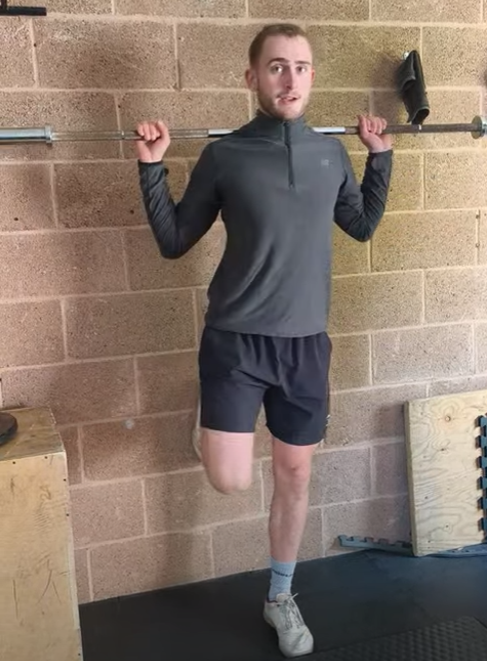
Dylan came to me post-ACL reconstruction. Twenty-five weeks of phased work later, his team has moved him from centre-back to up-top because of the speed he gained in rehab. He came off the bench in his third match back and had two assists. Read the full story.
Three ways to work with me
Assessment + 12-week plan — £180. A 90-minute in-person assessment with a written plan you can follow on your own or alongside your physio. The right starting point if you want a clear, expert framework without ongoing coaching.
Return to Play — Phase Block — £840. Twelve coached sessions over 10–14 weeks, with a written end-of-phase report. For the heart of the rehab journey — typically weeks 5–22 post-op.
Full Return to Play Programme — £1,750. Twenty-six coached sessions over six months. Phase reports at weeks 4, 12 and 24, plus liaison with your surgeon and physio. The full rehab programme, end-to-end.
All packages exclude venue costs, kit, and on-field match-day attendance. Payment in two instalments: 50% on sign-up, balance at week 12 for the longer programmes.
Get in touch
Based in Willand, Devon. I work with athletes within 45 minutes of the gym, plus referrals from surgeons and physios across the South West.
Email: excelsiorathletic@gmail.com More writing on rehab and youth athletic development: Coaches’ Corner on Substack Books and articles: excelsiorgroup.co.uk
James Marshall — head coach, Excelsior Athletic Development Club. Two Olympic Games, British Champions in weightlifting, four published books on athletic development.