
Coach education: the micro practice
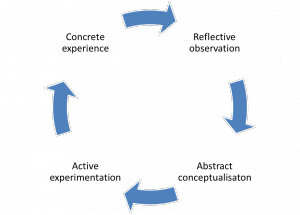
“Learning does not happen automatically as a result of experience”
 Thompson
Instead, we have to reflect upon the experience, relate it to some theory and then try it out again (Kolb).
However, I have been on far too many coaching workshops where you just sit and listen to some expert.
Some interesting ideas come up, but by the time you get back to your team or players you have either forgotten what it was you learnt, or you are unable to deliver the idea as well as you would like.
The Micropractice
I got this idea from Doug Lemov’s “Practice Perfect”. At the latest CPD workshop I ran for the Excelsior Community of Practice every coach got the chance to give and receive feedback on a session they delivered on Sunday.
Each coach delivered a two minute coaching session. Two other coaches observed and had to give feedback on it, each one starting with a specific phrase:
- “You did a good job of…”
- “Next time, try…”
The coach then either continued on with their session, or restarted it for another two minutes. We then repeated the process.
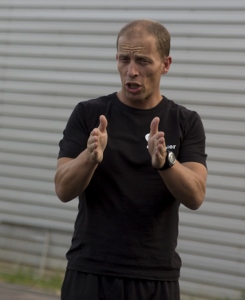 At the end of the two or three sessions, the participants evaluated how well the coach implemented the feedback. As coaches we give a lot of feedback, but we are rarely assessed on how effective it is.
By holding cards which had the two feedback phrases written on them, we neutralised the personal aspect of resistance to receiving feedback (of course, the type of people attending this workshop had a genuine desire to learn and improve, so it was a skewed sample).
This took about six minutes for each coach, but we had additional discussions around the format. Six minutes! Imagine if we could do this every week? How effective would that be? A continuous cycle of improvement looking at one small skill at a time.
Each coach had something tangible to take away and put into practice on Monday morning.
Coaching Pedagogy: blending science with art
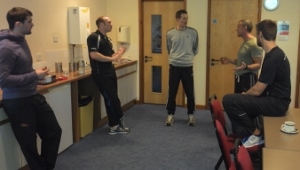 Whenever coach pedagogy is mentioned, people run for the hills! This workshop was designed to help everyone improve their practice.
A lot of coaches rely on “Practice theories” which is often known as common sense.
However, an underlying theory is “Necessary to avoid assumptions, prejudices and stereotypes” (Thompson). But, this theory has to be robust and I used a recent publication on “swim sprint training” as an example of poor research and misinterpretation of data.
Each coach came armed with a theory of their choice that helps inform their practice, and then talked about how to use it. I was expecting a lot of jargon based around “force platforms” or “dynamic correspondence“.
Instead, every coach presented a theory based around motivation, behaviour or understanding the person who is also an athlete. This became a very useful discussion on the “how we coach” rather than the “what we coach“.
In conclusion Coaching could be called the “Optimal integration of theory and practice“.
Thanks to everyone who took part, I am looking forward to the next workshop in March.
Further reading
- Coach development: one size does not fit all.
- “Theory and practice in human services” Neil Thompson (2000)
- “Learning Styles and Learning Spaces: Enhancing Experiential Learning in Higher Education” Kolb & Kolb (2005)
With most coaches working as individuals it was very helpful to have others observe and make constructive comments so we could then improve our session then and straight away when we got back to our athletes.
I have already used the comments to good effect and run the coaches through the stretching with plenty of laughter
Looking forward to the next workshop
Duncan
Thanks Duncan, I forgot to mention the fact that we had fun (and mince pies).
Thanks james
It was a good afternoon. Always good to hear your thoughts and learnings.
I appreciated the immediate way that unbias observations both good and bad can have on improving coaching and the coach.
I put some of the ideas that you and the lads taught in to practice on monday and they were well received.
Also I enjoyed mixing with the others to exchange views and make the tea!
Happy Christmas and see you soon.
Cheers
James Buckingham
Pfpexeter
The tea breaks are an essential part of our “informal learning”. Thanks for all your ideas and suggestions.
Sad to have missed such an exciting workshop but the report is very helpful all the same.
Thanks for keeping me in the loop and giving me food for thought.
Mark
[…] structure was similar to the micropractice work we did in […]
[…] Coach education: the micro practice. […]
[…] Princess Royal Sports Complex: Coach education (The micro practice) […]